
Nose Bleeds
Nose bleeds are a common childhood condition and are normally self-limiting. It is most commonly caused by minor injury to the nose lining such as nose picking but can also be caused if your child has had a recent cough/runny nose (viral upper respiratory tract infection), if they have allergic rhinitis, or a foreign body in their nasal passage. Only very rarely can it be due to a bleeding disorder. The bleeding is usually from the front part of the nose and whilst the amount of bleeding may seem like a lot (such as soaking through tissues), it is rare for children to lose so much blood that it causes any problems (such as anaemia). This is only to be likely with frequent, heavy nosebleeds over several weeks or months.
The advice below should help you decide whether your child’s nose bleed requires further help or whether it can be managed by yourself at home.
Red
If your child has any of the following:
- If your child is on medication that prevents blood clotting (such as warfarin, heparin or aspirin)
- If your child is less than 2 years old
- If the nose bleed has been ongoing for more than 30 minutes despite appropriate first aid.
- If the nose bleed is from both nostrils (this suggests a nose bleed from the back of the nasal passageway)
- If despite sitting your child upright and getting them to lean forward, they are choking on the blood (this suggests a nose bleed from the back of the nasal passageway)
- If your child has significant disfigurement to their nose after injury to the face.
You need urgent help.
Go to the nearest Hospital Emergency (A&E) Department or phone 999
(first aid should be started simultaneously – see below)
Amber
If your child has any of the following:
- If there is a discharge from the nose alongside the nose bleed (as this may be due to a foreign body in the nose)
- If your child has frequent small volume nose bleeds that respond to first aid.
- If your child has nose bleeds and bruised skin anywhere on the body or a family history of a bleeding disorder
You need to contact a doctor or nurse today.
Please ring your GP surgery or call NHS 111 - dial 111
(first aid should be started simultaneously – see below)
Green
If none of the above features are present:
Care using the advice below, can be provided to your child at home if none of the above features are present. If your child continues to get frequent nose bleeds, please arrange to speak to your GP or practice nurse.
Self care
Continue providing your child’s care at home. If you are still concerned about your child, speak to your health visitor, local pharmacist or call NHS 111– dial 111
First aid for nose bleeds:
Apply continuous pressure for 20 minutes to the fleshy front part of the nose by pinching it between index finger and thumb. Keep the child sitting up and leaning forward, breathing through their mouth (see diagram below). Encourage them not to swallow the blood but instead to spit it out, as swallowing blood can cause them to vomit which can then trigger the nose bleeding to restart.
Keep talking to your child with reassurance and keep them as calm as possible. It is tempting to release the pressure from the nose to check if the bleeding has stopped, but do not do so until the 20 minutes has finished. If there is ice available, then your child can also suck on some ice during this time or an ice-pack can be placed on their forehead or on the nape of their neck. Giving them a cool drink can also help them cool down.
If there is ongoing bleeding – recheck that the position of the pressure being applied is correct and apply pressure for a further 10 minutes
If at this point, there is ongoing bleeding then call an ambulance and calmly continue applying first aid measu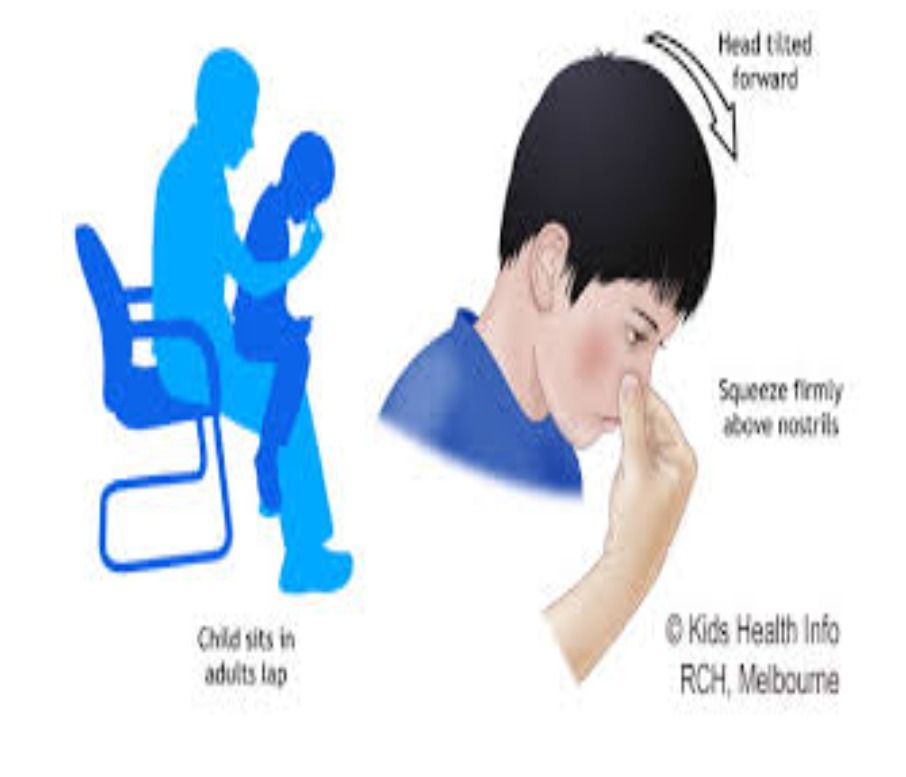 res until they arrive.
First aid for nose bleeds:
Apply continuous pressure for 20 minutes to the fleshy front part of the nose by pinching it between index finger and thumb. Keep the child sitting up and leaning forward, breathing through their mouth (see diagram below). Encourage them not to swallow the blood but instead to spit it out, as swallowing blood can cause them to vomit which can then trigger the nose bleeding to restart.
Keep talking to your child with reassurance and keep them as calm as possible. It is tempting to release the pressure from the nose to check if the bleeding has stopped, but do not do so until the 20 minutes has finished. If there is ice available, then your child can also suck on some ice during this time or an ice-pack can be placed on their forehead or on the nape of their neck. Giving them a cool drink can also help them cool down.
If there is ongoing bleeding – recheck that the position of the pressure being applied is correct and apply pressure for a further 10 minutes
If at this point, there is ongoing bleeding then call an ambulance and calmly continue applying first aid measures until they arrive.